Educational / Student Teams
Model B747 Wing Vibration Study
ME 318 · Cal Poly · Team of Two · November 2025
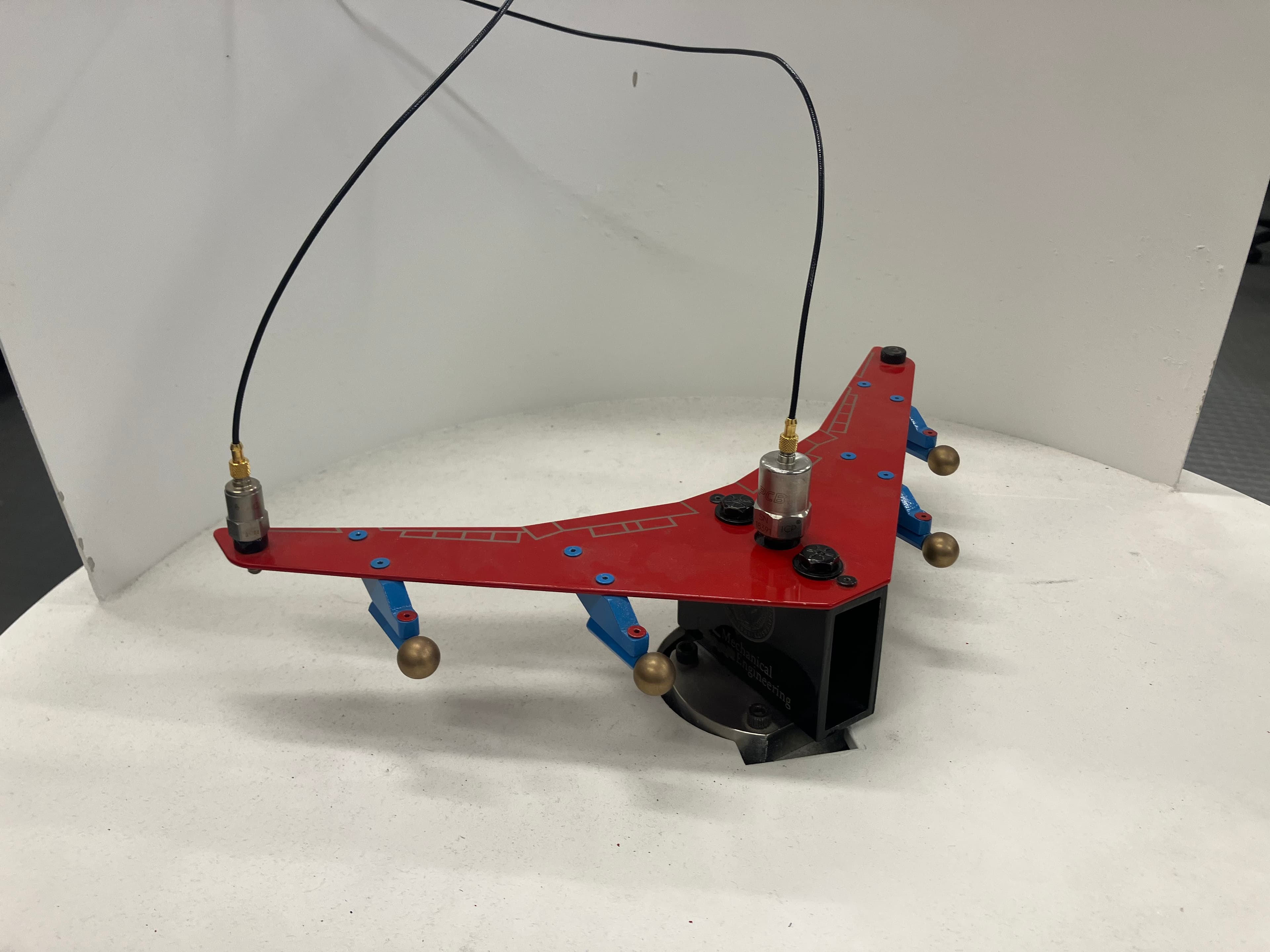
Used a spectral analyzer in the lab to compare analytical, simulated, and experimental results for the first natural frequency of the model Boeing 747 aircraft wing.
Overview
This project compared three methods of predicting a model B747 wing’s first natural frequency: analytical hand calculations, SolidWorks modal analysis, and experimental testing.
My Role
Completed the analytical hand calculations and performed the vibration analysis in SolidWorks Simulation.
Hand Calculations
Estimated the first natural frequency using analytical vibration methods.
Theoretical natural frequency
39.9 Hz
SolidWorks Simulation
Built the modal analysis, generated the finite element mesh with a convergence study, and evaluated the first vibration mode.
Simulated natural frequency
32.2 Hz
Experimental Testing
Excited the wing using a shake table and measured its response with accelerometers and a spectral analyzer.
Measured natural frequency
33.8 Hz
Comparison
The SolidWorks result closely matched the experimental measurement, while the analytical model predicted a higher frequency because of its simplifying assumptions.
Hand calculations
39.9 Hz
SolidWorks FEA
32.2 Hz
Experimental result
33.8 Hz
Reflection
This project strengthened my understanding of structural vibration and reinforced the importance of validating analytical and computational models with experimental data.