Personal
Casting Furnace
Personal Project · April-May 2026
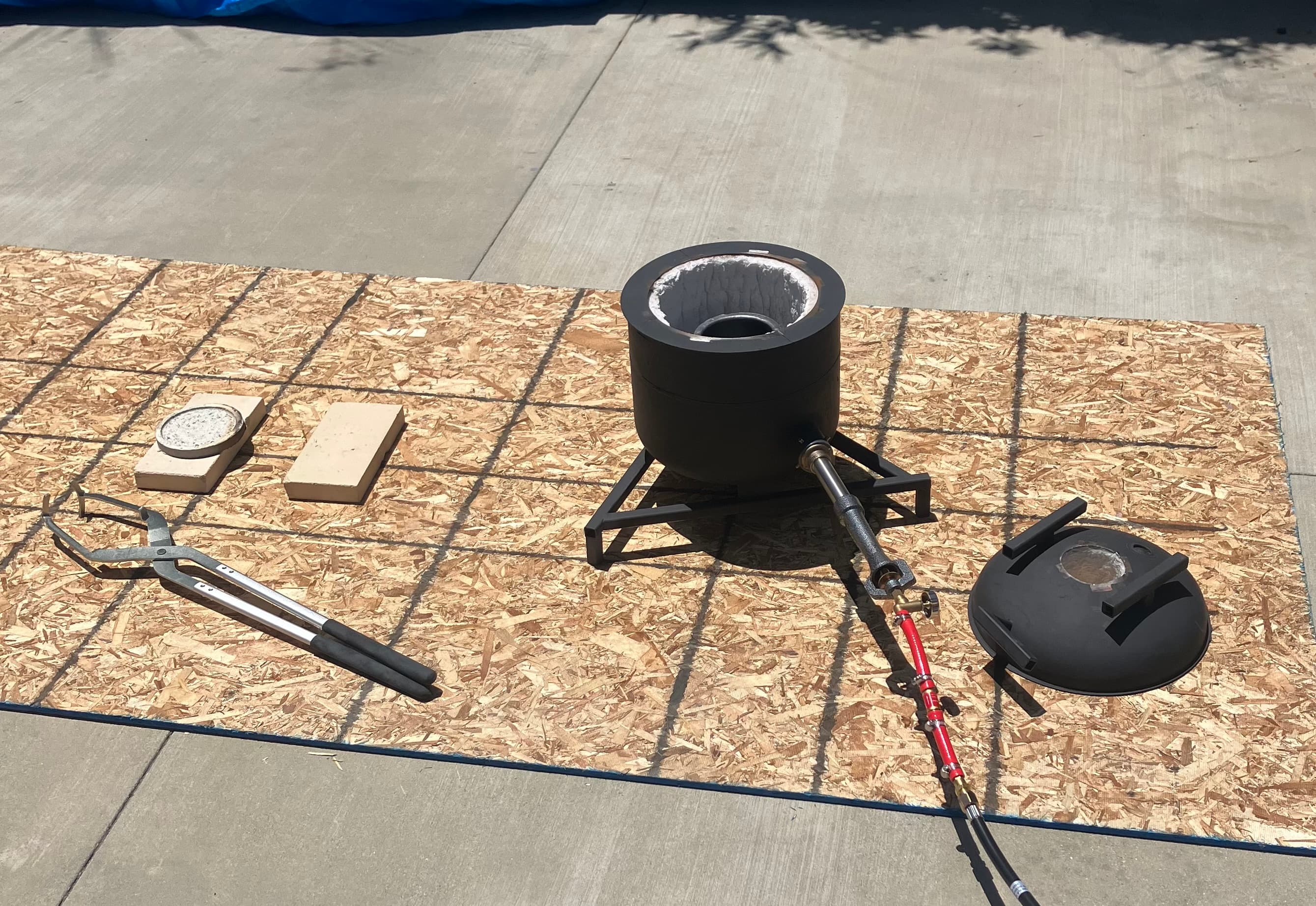
A propane-fired metal casting furnace built from a salvaged helium canister, capable of exceeding 2100°F whilst operating from a standard propane tank.
Overview
Redesigned and fabricated a discarded helium canister into a compact propane-fired furnace for metal casting, recycling materials wherever possible and manufacturing custom components to safely sustain temperatures above 2100°F.
My Role
Designed and fabricated the furnace, selected the refractory and insulating materials, manufactured custom components, tested it's capabilities under careful monitoring, and completed heat-transfer calculations to evaluate its thermal performance.
Project Overview
The project began with a discarded helium canister that I found on the street and wanted to repurpose into a furnace for small-scale metal casting. After safely relieving the remaining pressure, I modified the vessel to accommodate the refractory lining, ceramic insulation, burner inlet, and structural hardware. The furnace was designed around a standard propane supply whilst targeting temperatures sufficient for melting common aluminum and copper alloys.
Furnace Construction
The furnace was constructed with a refractory-cement base and approximately two inches of high-temperature ceramic insulation surrounding the combustion chamber. A runoff opening was incorporated into the base to provide a controlled path for molten metal in the event of a crucible failure. I also welded external handles and fabricated the burner interface and gate to direct the propane flame tangentially into the chamber, promoting circulation and more uniform heating. The exterior was finished with a high-temperature ceramic coating.
Thermal Analysis
During steady-state operation, I took many readings of the exterior surface temperatures using an infrared thermometer and the specified emissivity of the ceramic coating. These measurements were used to estimate conductive, convective, and radiative heat losses through the furnace walls and evaluate its thermal performance. The analytical model intentionally excluded heat transfer through the lid and base, where a substantial portion of the actual heat loss occurs, and estimated burner output without a complete combustion analysis. Consequently, the calculated thermal efficiency should be interpreted as an idealized upper limit rather than the furnace's true overall efficiency.
Peak measured temperature
2136°F
Maximum rated power
29.3 kW
Calculated thermal efficiency*
98.4%
Design Results
The completed furnace successfully exceeded the original temperature target, reaching a measured maximum of 2136°F whilst operating at less than 2 psig from a standard propane supply. The refractory lining, ceramic insulation, and exterior structure remained functional throughout testing, demonstrating that the furnace could safely sustain the temperatures required for small-scale metal casting.
Maximum measured temperature
2136°F
Maximum rated power
29.3 kW
Operating pressure
<2 psig
Ceramic insulation thickness
~2 in
Calculated thermal efficiency*
98.4%
Total Project Cost
$295
Sand Casting Flask
To complement the furnace, I designed a wooden flask consisting of a cope and drag for future sand casting. Since my father is an avid woodworker, I commissioned him to make the flask from my design using scrap wood he already had available. The completed flask will be used with Petrobond sand and 3D-printed patterns to produce detailed metal castings.
Reflection & Next Steps
This project gave me an opportunity to apply heat-transfer principles directly to a system I designed and fabricated myself, particularly when determining how to protect the furnace's structural components from the extreme temperatures inside the chamber. Building and testing the complete system also reinforced the importance of understanding the limitations of simplified analytical models when evaluating real thermal systems. With the furnace and casting flask complete, I am excited to begin producing my own cast components using 3D-printed patterns and Petrobond sand.