Personal
Compact Desalination Kit
Personal Project · January 2026
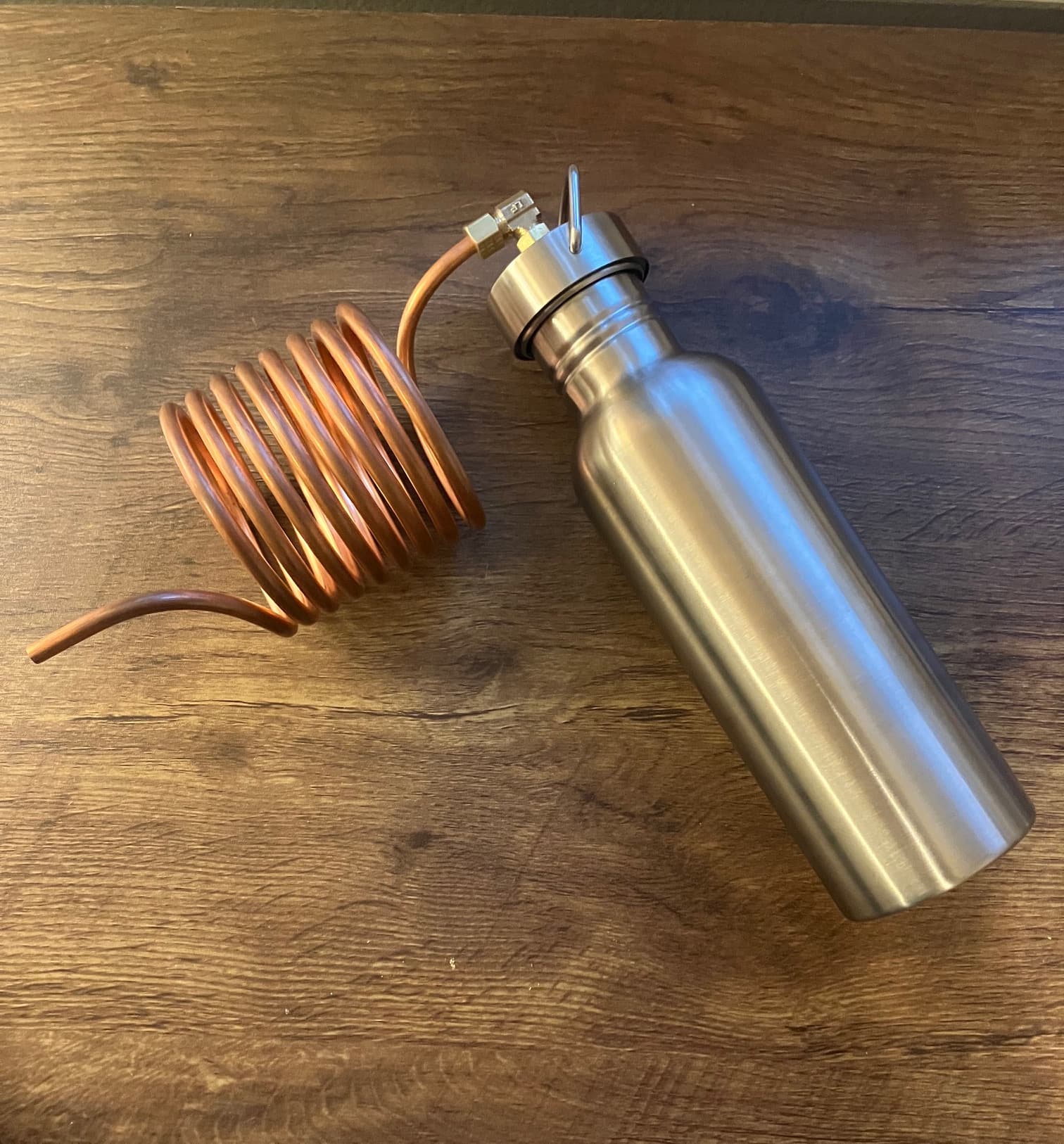
A compact thermal desalination device built from copper tubing and a stainless-steel bottle, recovering approximately 55% of its input water as liquid condensate.
Overview
Designed and assembled a compact proof-of-concept desalination kit that boils saltwater and routes the resulting vapor through a coiled copper condenser. Testing on a kitchen stove showed that approximately 55% of the initial water mass was recovered as liquid output.
My Role
Developed the device layout, formed and fitted the copper tubing, modified and sealed the bottle cap, assembled the required fittings, and conducted the initial mass-based recovery test.
Project Overview
This project explored whether a simple thermal desalination device could be made compact enough to store with my camping equipment. The system uses a stainless-steel bottle as the boiling vessel and a length of copper tubing as the vapor path and condenser. When saltwater is heated, water vapor travels through the tubing, cools, and condenses into a separate collection container whilst the dissolved salts remain in the bottle.
Construction
The copper tubing was cut to length and carefully wound around the stainless-steel bottle to create a compact condenser. I drilled through the bottle cap, passed the tubing through the opening, and sealed the joint with lead-free solder to limit vapor leakage. Additional fittings were then installed to complete the assembly and provide a controlled outlet for the condensed water.
Experimental Testing
For initial testing, I heated a measured quantity of water in the bottle using a kitchen stove and collected the liquid discharged from the condenser. Comparing the input and output masses showed that approximately 55% of the starting water was recovered as liquid. The remaining mass was primarily lost as uncollected water vapor through incomplete condensation or leakage from the system. I found that placing a damp cloth around the coils increased the amount of liquid condensed.
Liquid-water recovery
~55% by mass
Heat source
Kitchen stove
Design Results
The completed system successfully demonstrated the basic desalination process in a compact, portable assembly. Vapor generated in the stainless-steel bottle traveled through the copper coil and condensed into a separate liquid output. Although the 55% recovery rate leaves considerable room for improvement, the test confirmed that the device can perform its intended function at a basic level.
Liquid-water recovery
~55% by mass
Boiling vessel
Stainless-steel bottle
Condenser
Coiled copper tubing
Heat source used during testing
Kitchen stove
Reflection & Next Steps
This was a straightforward and enjoyable project that turned a small group of common components into a functioning thermal separation system. I do not anticipate needing it often, but its compact size made it an easy addition to my camping equipment. A future revision could improve the seal within the elbow connector, extend or actively cool the condenser, and better insulate the boiling vessel to increase liquid recovery and reduce energy loss.