Personal
Rocket Stove
Personal Project · April-May 2025
A wood-burning rocket stove designed and fabricated from $18 of salvaged steel for cooking meals outdoors.
Overview
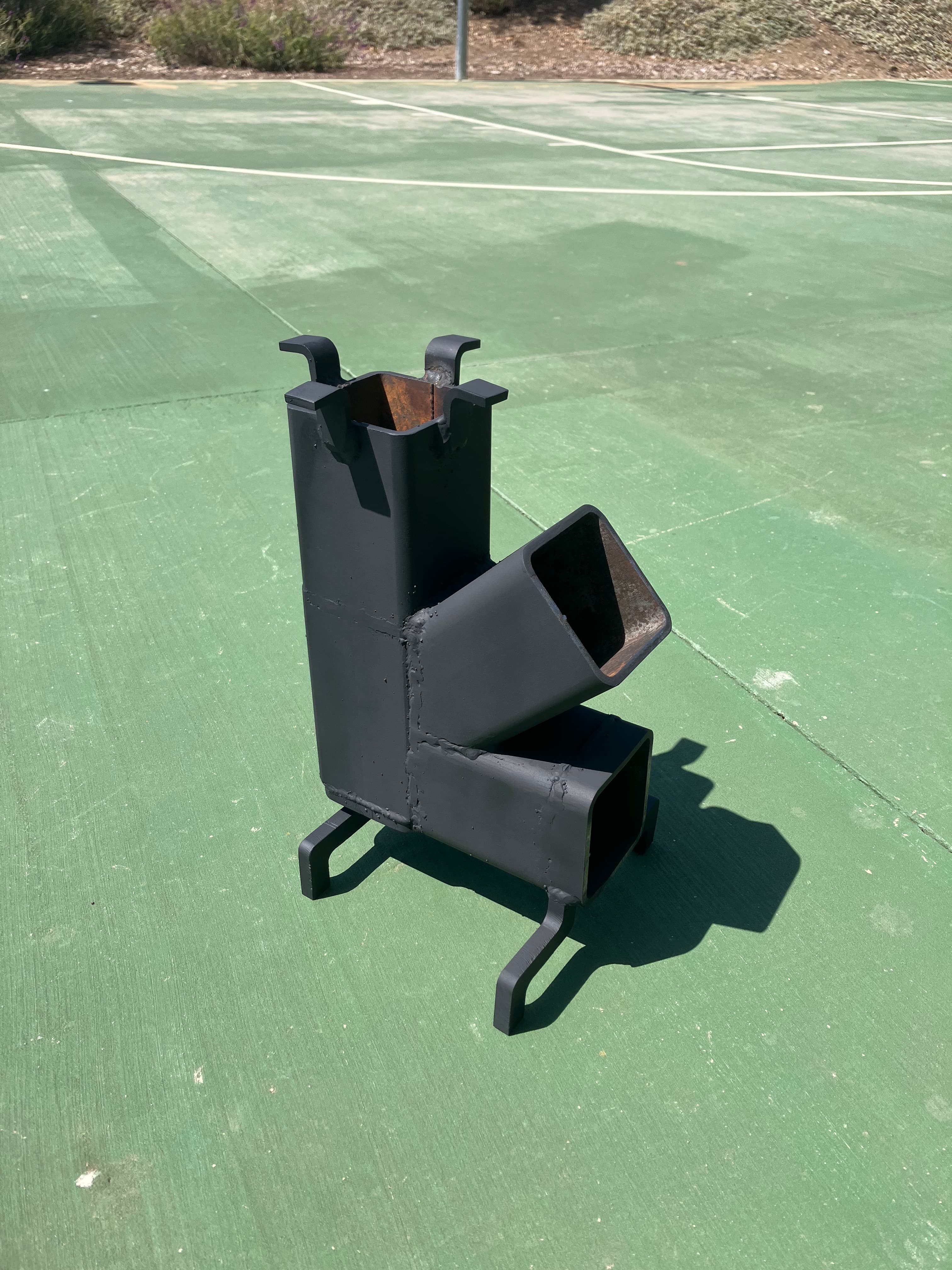
Designed, welded, and experimentally evaluated a (somewhat) portable rocket stove using square steel tubing sourced from a local salvage yard. A water-boiling test and published wood-combustion data were used to estimate its heating power, thermal efficiency, and carbon emissions.
My Role
Developed the stove geometry, selected and prepared the salvaged material, fabricated the assembly through sawing, waterjet cutting, and MIG welding, applied a high-temperature ceramic coating, conducted the water-boiling test, and completed the thermodynamic analysis.
Project Overview
The project began after I found suitable square steel tubing at a local salvage yard and decided to repurpose it into a wood-burning stove for camping. The stove was intended to provide a simple alternative to carrying propane while making use of inexpensive reclaimed material. Its geometry directs fuel and airflow into a compact combustion chamber before routing the hot exhaust toward the cooking surface.
Fabrication
The salvaged tubing was cut into the required sections and MIG welded to form the fuel inlet, combustion chamber, chimney, and supporting structure. After fabrication, I cleaned the completed assembly and applied a high-temperature ceramic coating to protect the exterior during repeated use. The finished stove weighs 38 pounds and was constructed using approximately $18 of scrap steel.
Experimental Testing
To evaluate the completed stove, I performed a water-boiling test while measuring the mass quantity and type of wood consumed. The temperature change and mass of the water were used to estimate the useful heat transferred during the test. Published wood-combustion performance data from William Strauss and FutureMetrics were then used to estimate the energy supplied by the fuel and the associated carbon emissions.
Thermal Analysis
The experimental measurements were combined with published fuel data to estimate the stove's useful heating power, thermal efficiency, and emissions. The analysis produced an estimated output of 278 W and a thermal efficiency of 2.68%. Because the calculation is based on a simplified water-boiling test and reference combustion data rather than direct exhaust or heat-flux measurements, these results should be treated as approximate performance estimates.
Estimated useful power
278 W
Estimated thermal efficiency
2.68%
Estimated emissions
0.397 kg CO₂/kWh
Design Results
The completed stove successfully burned small pieces of wood and produced sufficient heat for outdoor cooking. Although its measured performance was modest, it demonstrated that a functional cooking system could be fabricated from inexpensive salvaged material. Its 38-pound weight makes it better suited to car camping than backpacking, but its simple construction and readily available fuel make it really fun to use outdoors.
Salvaged material cost
$18
Completed weight
38 lb
Estimated useful power
278 W
Estimated thermal efficiency
2.68%
Estimated emissions intensity
0.397 kg CO₂/kWh
Reference natural-gas generation
0.181 kg CO₂/kWh
Reflection & Next Steps
The stove was neither particularly powerful nor efficient, and the analysis suggests that its emissions per unit of useful energy are higher than the reference value for typical natural-gas power plants. Even so, the stove has cooked several memorable outdoor meals and made productive use of material that might otherwise have remained scrap. A future version could reduce weight and refine the airflow path to promote better heat transfer to the cookware.