Professional
O-Ring Installation Tool
BIW Connector Systems · Product Design Engineering · Summer 2026
A reverse-engineered O-ring installation tool redesigned for compatibility with a broader range of internal O-ring glands, enabling faster and less intrusive installation.
Overview
Reverse-engineered and redesigned a discontinued O-ring installation tool to improve its manufacturability, serviceability, and compatibility with a wider range of internal O-ring glands.
My Role
Analyzed the existing tool, developed the replacement assembly in Creo Parametric, designed seven custom components, incorporated feedback from a formal engineering design review, coordinated prototype printing, and documented the project for continuation after my internship.
Project Overview
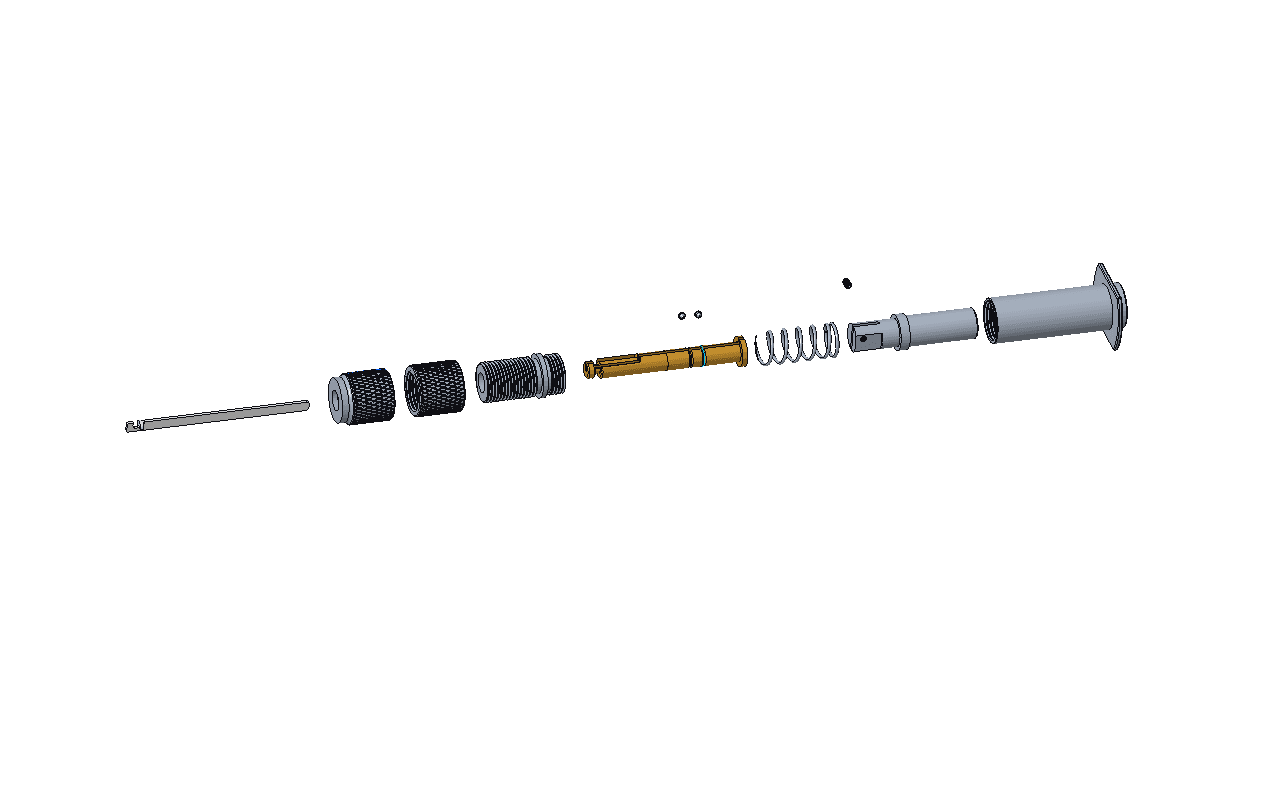
This project began near the end of my internship while several of my other designs were awaiting approval from the purchasing and manufacturing teams. The existing O-ring installation tool had been discontinued by its original supplier, creating the need for a reverse-engineered replacement. I evaluated how the original mechanism operated, identified limitations in its assembly and interchangeability, and developed a revised design for use with a wider range of internal O-ring glands.
Reverse Engineering
I disassembled the existing tool to understand the function of each component and determine which features should be retained or improved. Particular attention was given to the spring-loaded mechanism, threaded connections, and methods used to retain the internal components. This analysis established the functional requirements and key dimensions for the replacement design.
Initial CAD Design
I modeled the initial design in Creo Parametric as an 11-component assembly. Four components, including the spring and set screws, were selected from outside suppliers, while the remaining seven components were designed from scratch. The models incorporated fully defined threads, knurling, and the internal geometry required to guide the O-ring during installation.
Total components
11
Custom-designed components
7
Sourced components
4
Manufacturability and Serviceability
The original brass insert and threaded connector were locked together by drilling and tapping directly across their material interface. This made the assembly difficult to disassemble and prevented the inserts from being readily interchanged. In the revised design, I milled a flat into the threaded insert and located the retaining set screw from the side. The set screw remained below the minor diameter of the mating thread, preventing interference during assembly. I also standardized the primary connections to 7/8-16 UNF threads in place of the original custom thread and replaced a permanent pinned connection with another removable set-screw connection.
Design Review and Revision
After completing the initial design, I led a review with the product design engineering team to present the assembly, proposed manufacturing approach, and anticipated timeline. The primary discussion centered on whether friction from the set screws would provide sufficient retention. Based on the team's feedback, I revised the connection to use a cone-point set screw engaging a circumferential groove in the mating insert. This created a positive mechanical lock while preserving the interchangeability and ease of disassembly provided by the original revision.
Prototype and Project Handoff
After incorporating the design-review feedback, I released the custom components for 3D printing to evaluate their fit and assembly. Because my internship ended shortly afterward, I prepared a detailed handoff report documenting the design decisions, calculations, supplier part numbers, manufacturing requirements, and remaining work. This allowed the next engineer to continue the project without repeating the reverse-engineering and development work.
Design Outcome
The project produced a fully modeled and physically prototyped replacement for the discontinued installation tool. The revised design replaced difficult-to-service connections, standardized the primary threads, and introduced interchangeable components intended to support a wider range of internal O-ring glands. Although my internship ended before the design could be manufactured and tested in its final material, the completed prototype and engineering handoff established a clear path for the next phase of development.
Total components
11
Custom-designed components
7
Standard thread
7/8-16 UNF
Reflection
I particularly enjoyed this project because it allowed me to apply reverse-engineering skills to a practical manufacturing problem. It also significantly improved my proficiency in Creo Parametric, especially when modeling functional threads, knurling, and unusual internal geometries. Leading the design review and preparing the final handoff documentation reinforced the importance of communicating design intent clearly, particularly when a project must be continued by another engineer.